
The Leadburn woodland and moss is now managed for its environmental value but it also has an interesting history featuring the junction of two former railway lines, a wartime armaments depot with a “laboratory”, and an experimental forestry trial plantation.
WW2 Royal Naval Armaments Depot
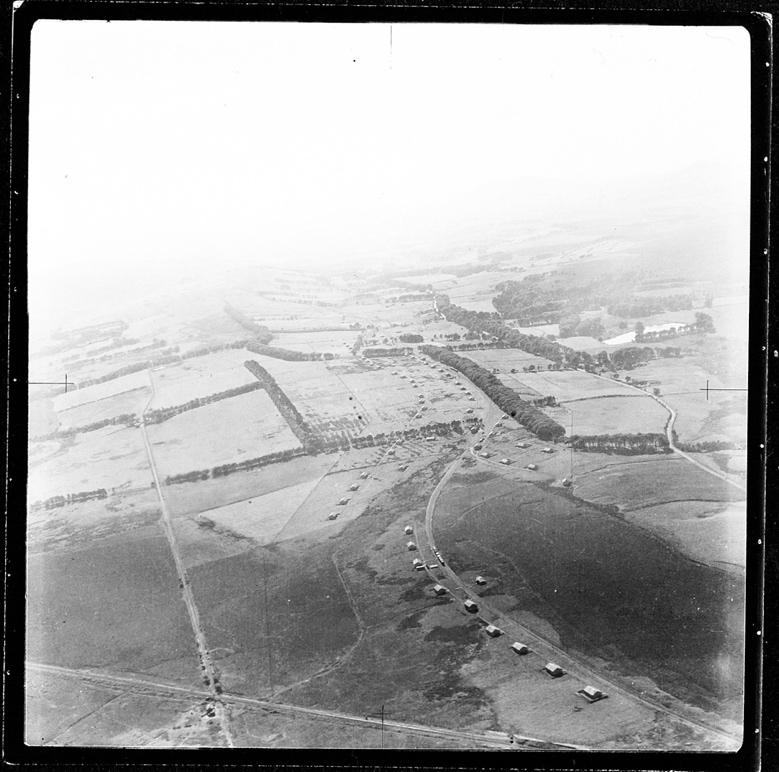
The Leadburn, Linton and Dolphinton Railway line (LLDR) closed in 1933 but was reopened at the commencement of WW2 when the area was requisitioned as a sub-depot of RNAD Crombie (Fife).
Over 100 huts were erected along the line for the storage of naval munitions and some RAF supplies. These were well separated and each protected with earth banking. The land between Leadburn and Whim was considered suitable for ammunition storage because the boggy ground would help to absorb any fallout from explosives or targeted bombing.
The remains of the ammunition stores, well spaced along the line can still be seen, with one cluster between Leadburn and Whim Farm and the other west of the old Macbie Hill station at Coalyburn.
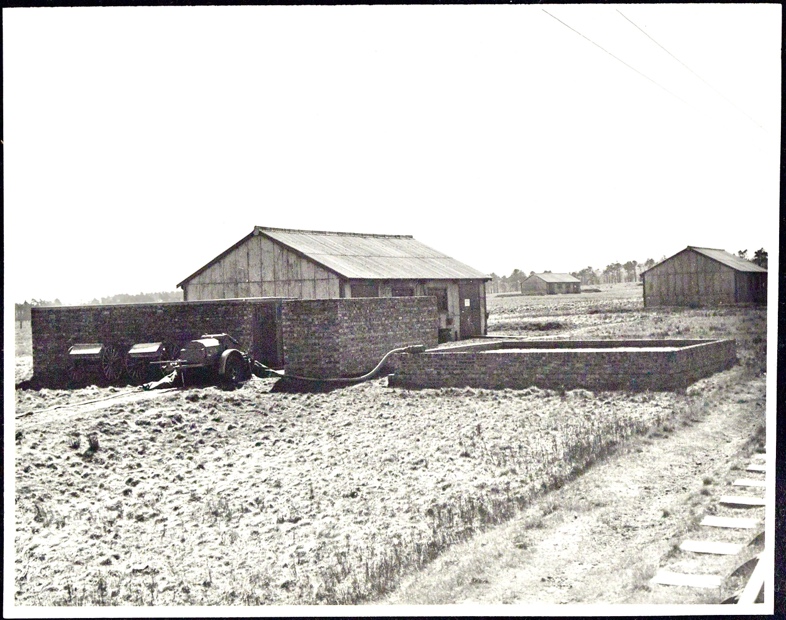
Trailer Pump Houses: along the line are the remains of several brick garages each with a water tank sunk into the ground in front. Each garage could house two fire trailer pumps.
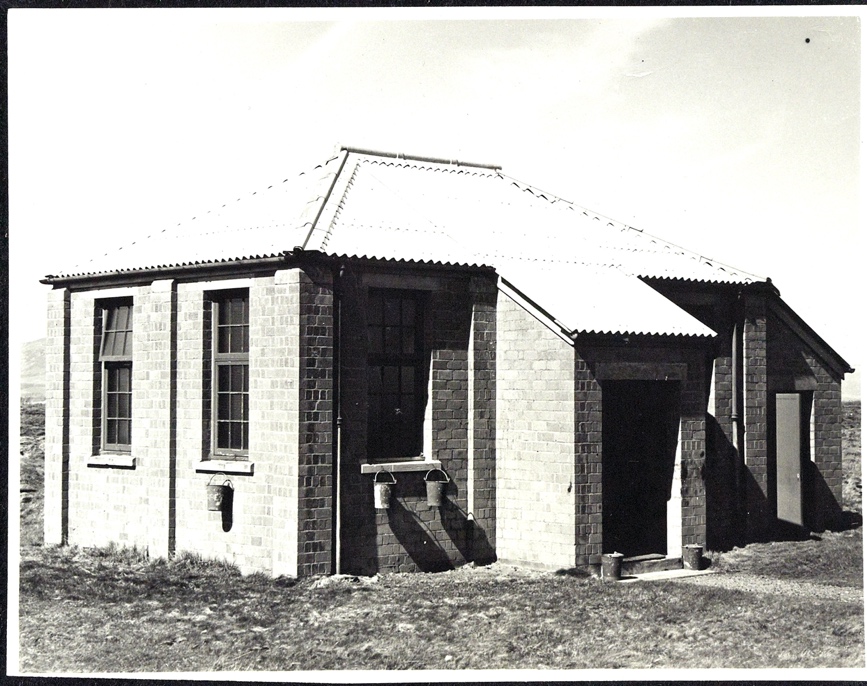
Brick Building: labelled ‘Laboratory’ on War Office photos. This would have been used for ammunition inspection, maintenance and safety testing. In the absence of electrical or other flammable illumination, the long windows allowed in as much daylight as possible.
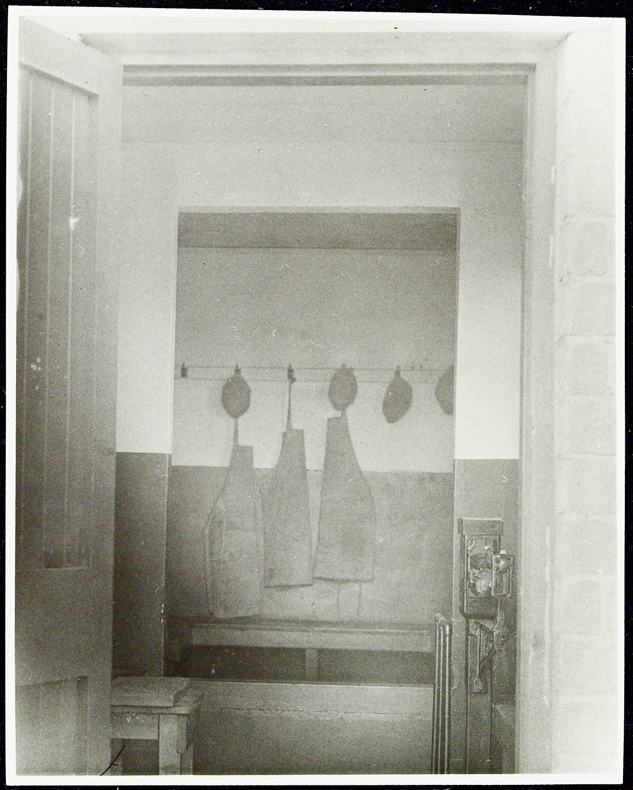
The side room on the right: The apron hooks suggest that a number of men worked in the ‘laboratory’. There was a small cast iron stove here.
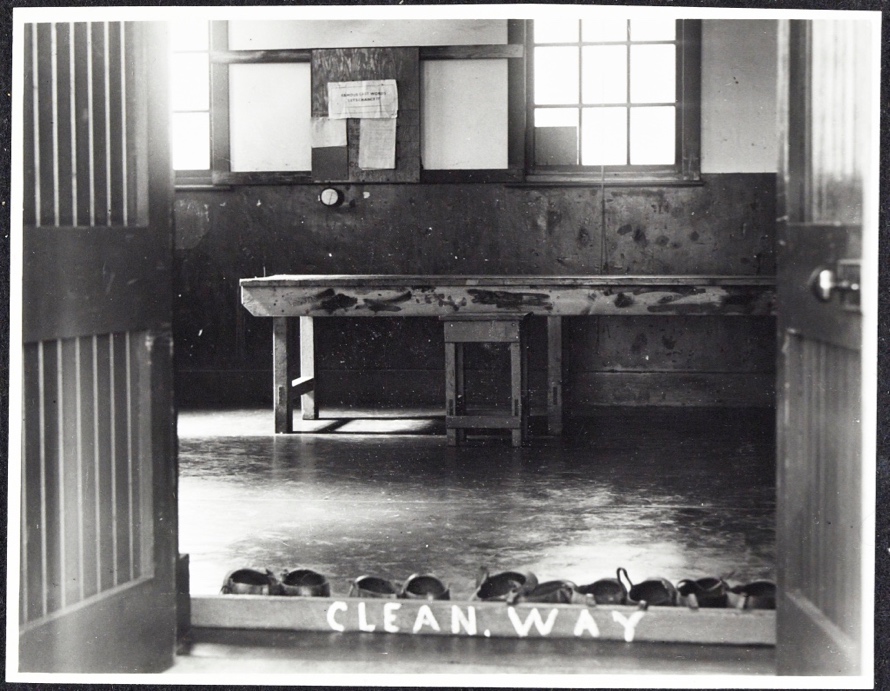
View into the interior from the main entrance. Note the row of clogs.
The notice on the back wall reads: “Famous Last words. Let’s chance it”
Photographs with permission, Hampshire Record Office: 109M91/65 and 109M91/133
The Coming of the Railways
Map image is Reproduced with the permission of the National Library of Scotland https://maps.nls.uk/
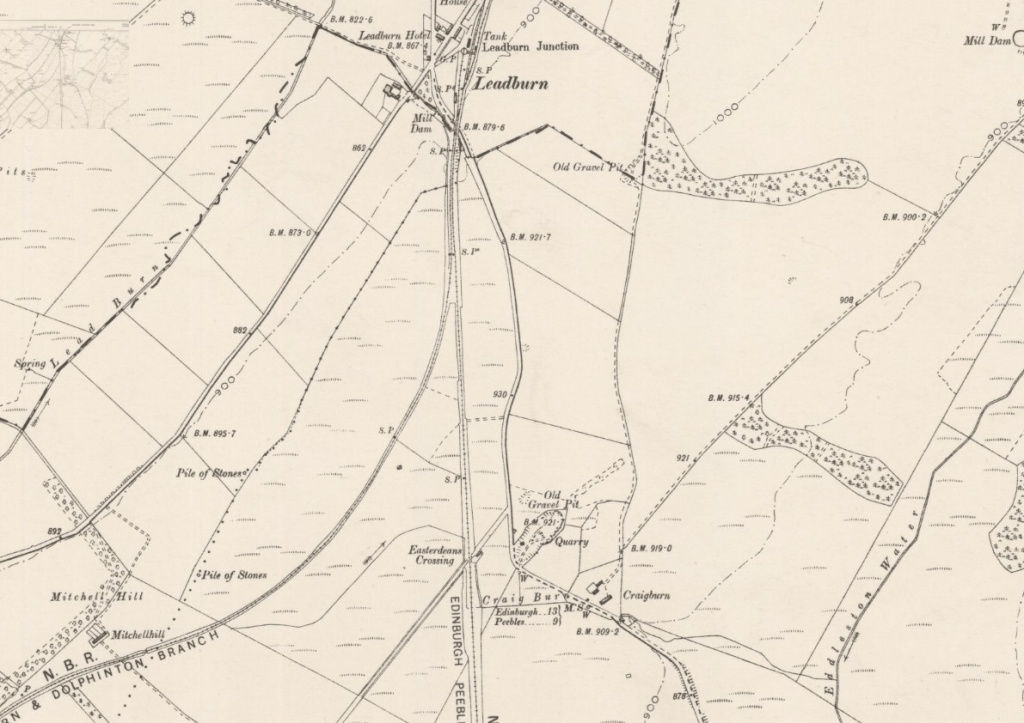
When the North British Railway (NBR) built the line from Edinburgh to Galashiels via Gorebridge and Stow, Peebles citizens felt isolated. The Peebles Railway company was therefore formed to oversee the construction and management of a line from Edinburgh to Peebles with an extension to Galashiels.
The Peebles Railway was opened on 4th July 1855, branching from the Edinburgh to Galashiels line at Eskbank (Hardengreen Junction). It was immediately very popular and over the first four months 40,000 passengers used the trains, an average of 330 a day
Then in 1864 Leadburn Station became an important junction when a branch line, run by the rival company NBR, was opened to Lamancha, Macbie Hill (Coalyburn), West Linton (Broomlee) and Dolphinton. Passengers embarked from a branch platform at Leadburn Junction. Both lines crossed the main A703 Peebles Road on an overhead bridge then divided at the northern end of what is now Leadburn Community Woodland. The foundations of these two lines provide the main paths through the Woodland.
In addition to local passengers, the Peebles line became popular for summer outings. Both railways also provided well-used freight services for lime, sandstone, coal, timber, agricultural products including livestock, and general merchandise. Traders could bring fresh wares to the country towns, in particular the Newhaven and Musselburgh fishwives who for the first time were able to bring their creels of fresh fish to sell in Peebles and West Linton.
The closure of the Railways
The Leadburn, Linton and Dolphinton branch-line never achieved the popularity of the Peebles line and was eventually closed in 1933 although it reopened during the 2nd World War to serve naval armament depots between Leadburn and MacbieHill (see WW2 Royal Naval Armaments Depot.)
Leadburn Station closed to passengers in 1955 but continued to handle goods and parcels until 1962 when the Peebles Railway line finally closed.
Dramatic Accident
A dramatic event occurred on 29th October 1863 during the construction of the Leadburn, Linton and Dophinton Railway line. A temporary access connection from Leadburn had been made at the request of the NBR, to transport construction materials.
On 29th October a train of five wagons arrived at Leadburn with iron girders and wooden sleepers for the new line. The wagons were parked at Leadburn to await the arrival of the contractor’s engine working on the branch line.
The engine arrived but first of all the driver, fireman, a stonemason and three foremen had a drink in the Leadburn Inn. Several drinks later they coupled up the engine and set off up the steep gradient beyond the Station.
It was a stormy evening with lashing rain and driving winds and the train slipped and slithered its way for about half a mile before coming to a standstill (in the Community Woodland area).
When the driver found a twisted link in the coupling between the engine and the wagons he uncoupled it. Despite having wedged the front wagon’s wheels,all five wagons started rolling back down the slope. They were, however, soon brought to a halt and the engine was backed down to attempt a re-coupling.
The driver was dealing with the wagons, so the fireman and stonemason were in charge. The engine jolted back, crashed into the front wagon and set the whole lot off again.
The runaway train hurtled back onto the main Peebles line, forcing the points and to the stationmaster’s astonishment, charged northwards through Leadburn at 15-20mph.
Meanwhile the 4.20pm express passenger train from Edinburgh was approaching the Tipperwell embankment near Howgate on the single line. In the inevitable crash that followed two wagons were forced under the passenger train’s engine, a third burst into flames. The fireman was catapulted on top of the first passenger carriage; the second carriage mounted the third and was crushed by the first.
Remarkably, although there were several injuries, there was only one fatality, the young son of the Peebles Railway Director Charles Tenant (Marshall, 2005). This cannot have furthered relationships between the two companies. Despite this, however, the Peebles Railway and North British Railway eventually merged in 1876.
(from Stories From The History of Howgate: Leadburn, by Alison MacDonald)
https://www.railwaysarchive.co.uk/docsummary.php?docID=7511
 LeadburnWood